
10,000 WWII Records Made Searchable at the Swiss Federal Archives
This project transformed a historical card catalogue of 10,000 Second World War records into a searchable digital resource, reducing discovery time from months to minutes.
Project outcomes
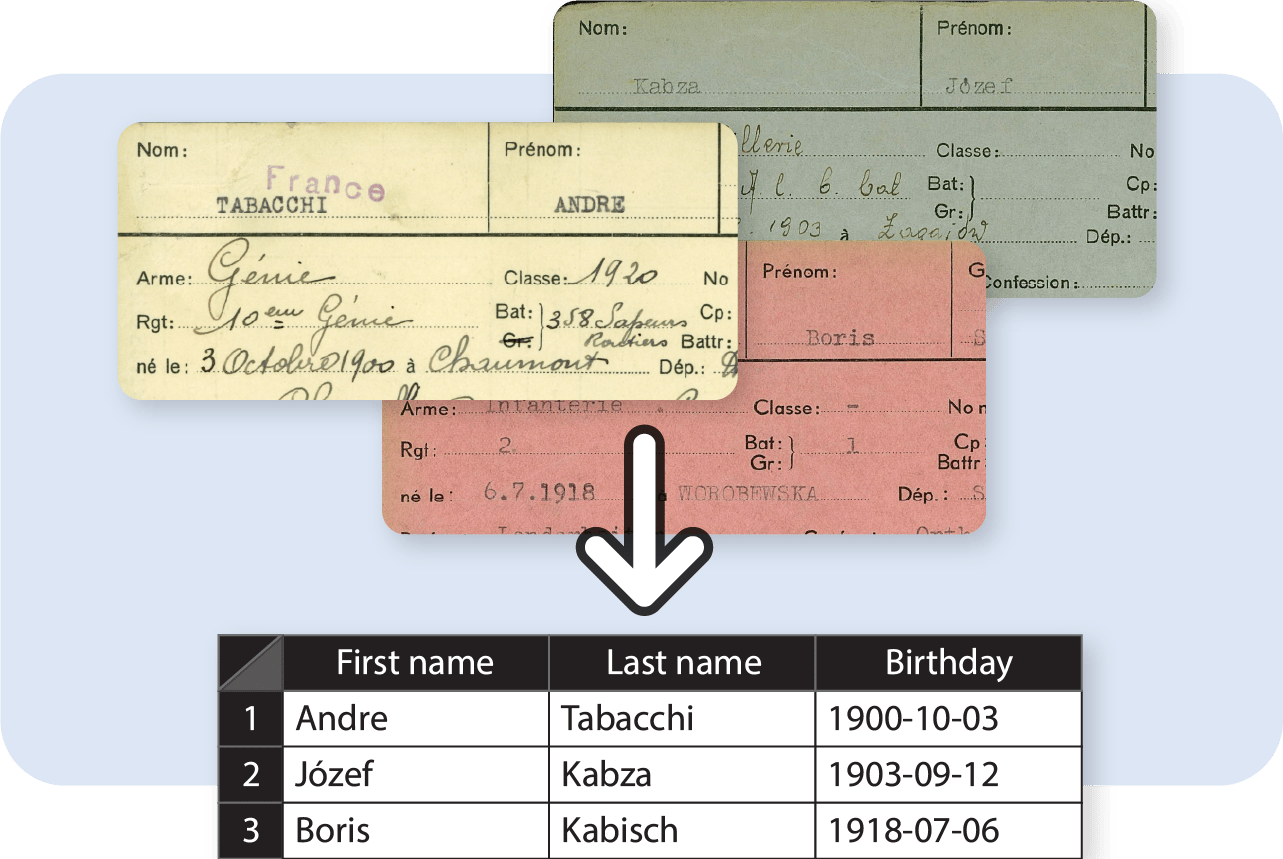
- 10,000 prisoner-of-war records were digitised, with key fields extracted using AI into structured data for search by name, birth date, and birthplace.
- Archive staff can now search across the collection in minutes instead of months, with researcher access planned for a future phase.
- Search interface links each record to its original digitised scan, preserving historical context.
The Issue: Preserved Collections, Limited Search
Many archival collections still live as physical cards, letters, and ledgers - carefully preserved but searchable only item by item - so asking research questions across an entire collection has not been possible.
This was the reality for the Swiss Federal Archives (BAR), which held a large collection of prisoner-of-war index cards documenting the fates of POWs, including critical historical details for families and historians, such as names, dates, places, camps, and movements.
At the start of this project, these cards were available only on-site in the archive reading rooms, and researchers had to review them card by card - a highly labour-intensive process.
The Innovation Challenge
Recognising the collection’s historical value, and the inefficiency of card-by-card research, the Swiss Federal Archives (BAR) launched an innovation challenge. The goal was to find a solution that would:
- Convert each card into structured, machine-readable data that computers and databases can search across.
- Enable archive staff to query and find records across the collection, replacing manual, card-by-card searching.
- Link every search result to its original digitised scan to preserve historical context.
The Solution: Making the Collection Searchable with AI, While Preserving Historical Context
In 2023, the Archipanion team implemented a pilot solution to use Artificial Intelligence (AI) to transform this collection into a searchable historical resource.
This work was based on three key steps:
-
OCR: Optical character recognition (OCR) tools (such as Google Vision and Tesseract OCR) were applied to each scanned index card to convert printed or handwritten text into machine-readable data.
-
Large Language Models (LLMs): LLMs (such as GPT-4 and Llama 2) were then used to analyse the text and transform it into structured datasets. This process directed the models to extract specific data fields from each card, such as first name, last name, and date and place of birth.
-
Collection Interface: The extracted data was then made available for search through a purpose-built web interface. The structured data is also available for export (CSV/Excel) for integration with Archival Information Systems (AIS) and research databases.
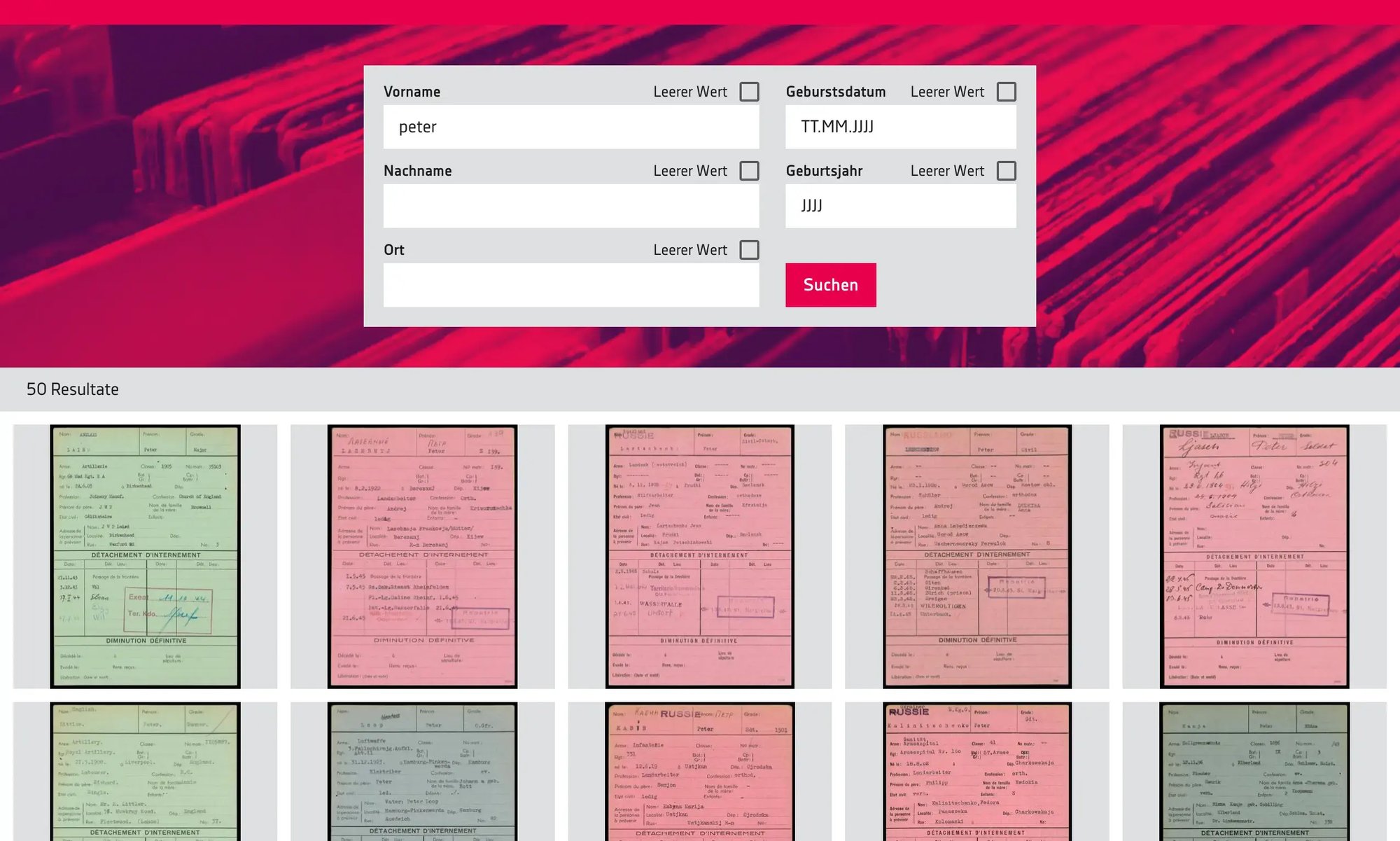
Screenshot of the purpose-built search interface. Each search result links to the original digitised scan, preserving historical context.
Results and Impact
After developing this three-step process, the team conducted a pilot project on 10,000 cards (the collection holds 500,000 in total). The results were as follows:
-
Efficiency Gains for Archival Workflows: Once the three-step process was in place, the AI-supported workflow enabled the digitisation and AI-cataloguing of 10,000 index cards in a very short timeframe. Without AI, undertaking data entry at this scale would have taken months, if not years, to complete.
-
Collection made searchable and more usable: The purpose-built search interface enabled the archive to be searchable at scale, allowing researchers to query all 10,000 records to discover patterns, trends, and links among people, places, and dates. Importantly, Archipanion also provided the structured data as CSV/Excel for integration with other research databases, enabling cross-referencing with other wartime records.
Lessons Learned & What’s Next
This partnership brought together AI and archival expertise. The expert knowledge of archivists was critical at many stages of the work, including deciding which data points to capture and reviewing output quality
This collaboration also enabled the Archipanion team to iterate as the work progressed, guided by archivist feedback. In the process, participating staff at the Swiss Federal Archives became more confident experimenting with AI technologies, developing a clear sense of what these tools can achieve.
Since this work was completed, AI has advanced significantly. Modern multimodal LLMs can now process scanned documents end-to-end, without a separate OCR step. This advancement further streamlines the workflow, reducing complexity, and, in many cases improving accuracy. This approach can now be applied across diverse archival collections, making them far more usable and accessible for researchers - and unlocking a wealth of stories still waiting to be told.