
Making 200 Environmental Films Searchable with AI at Amorce
Amorce, the public film platform of the Diazinteregio network, worked with Archipanion to make a selection of environmental films searchable by their content.
Summary
Diazinteregio is a network of 19 French-speaking film archives and moving-image heritage organisations, formed in 2010 to share a common collection-management tool, DIAZ, and to open regional film heritage to the public. Its members catalogue their collections in the shared DIAZ database and publish a selection of films to the free public platform Amorce. Sixteen members currently take part in Amorce.
Amorce worked with Archipanion to make a selection of environmental films searchable through AI Visual Search. Instead of relying only on catalogue descriptions, the search portal allows users to search the films by what appears in the footage itself, by text visible within a single frame, and by words spoken in the audio. The project covered more than 200 films and around 30 hours of archival footage.
The work began as a pilot, and the results are now available through a live public search portal.
Project outcomes
- More than 200 films made searchable by content. The environmental corpus brought together more than 200 films and around 30 hours of footage in a single search portal.
- Three search layers across one audiovisual collection. Users can search by visual content, by text visible within a frame, and by full-text audio transcript.
- Direct access to the relevant moment in a film. When a result is found within a film, the search portal opens playback at the relevant timestamp rather than leaving the user to scan through the whole reel.
- A route from one result to related footage. The search platform includes a “Visually similar results” function, allowing one useful visual result to be expanded into a wider set of related material.
- One test shared across a network. Films contributed by members of Diazinteregio allowed the network to assess AI search collectively, rather than each institution having to test it alone.
The challenge
Small audiovisual archives often work with limited budgets and small teams. Across the Diazinteregio network, members differ greatly in scale: operating budgets vary by a ratio of about 1 to 20, and the network brings together institutions of very different sizes and resources. Testing an unfamiliar technology individually is therefore much harder for some members than testing it once through the network.
There was also a difficulty specific to film itself. A catalogue record can describe a film as a whole, but it cannot realistically record every object, place, activity, scene, visual pattern, or piece of text that appears throughout the footage. In audiovisual collections, researchers and archivists often need to find one short moment inside a much longer film. Without timestamped content search, that kind of work can mean manually scanning long stretches of footage to locate a few relevant scenes.
Diazinteregio already addresses problems of scale through shared infrastructure. Its members work with one database, common standards for indexing and documentation, and a shared programme of training. Testing AI Visual Search followed the same principle: one shared pilot, on films drawn from across the network, producing results that all the members could evaluate.
How the search works
Refining a visual search
The visual-search layer supports specific multi-word queries. A search such as “women at work” can be narrowed to “women at work in fields”, showing how a broader visual query can be made more specific. Visual search also supports cross-language querying, so a user can search visually without depending on the language of the archival description.
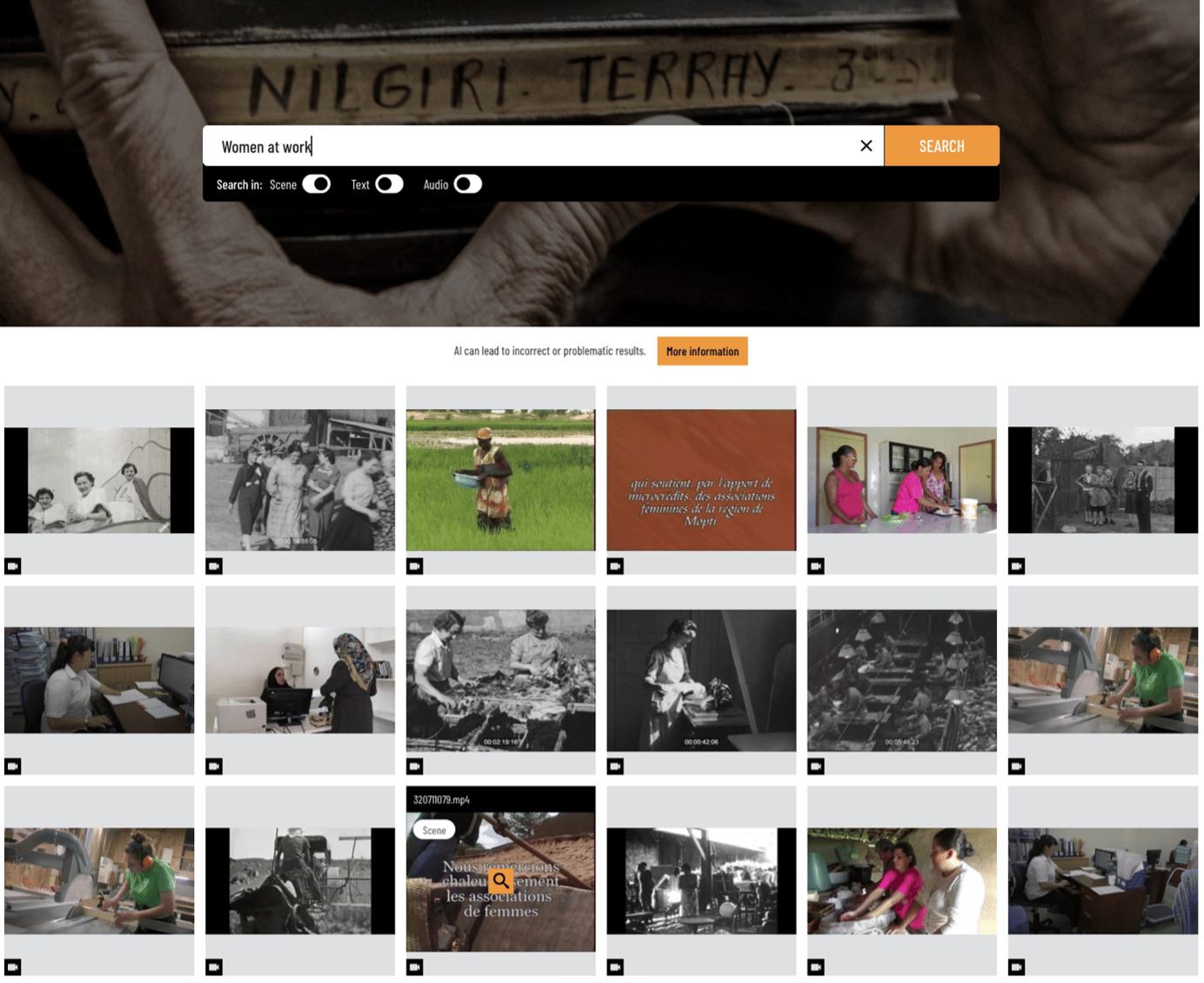
Image: Visual search results for “women at work”, showing a broad range of relevant scenes from across the Amorce collection.
Refining a visual search further
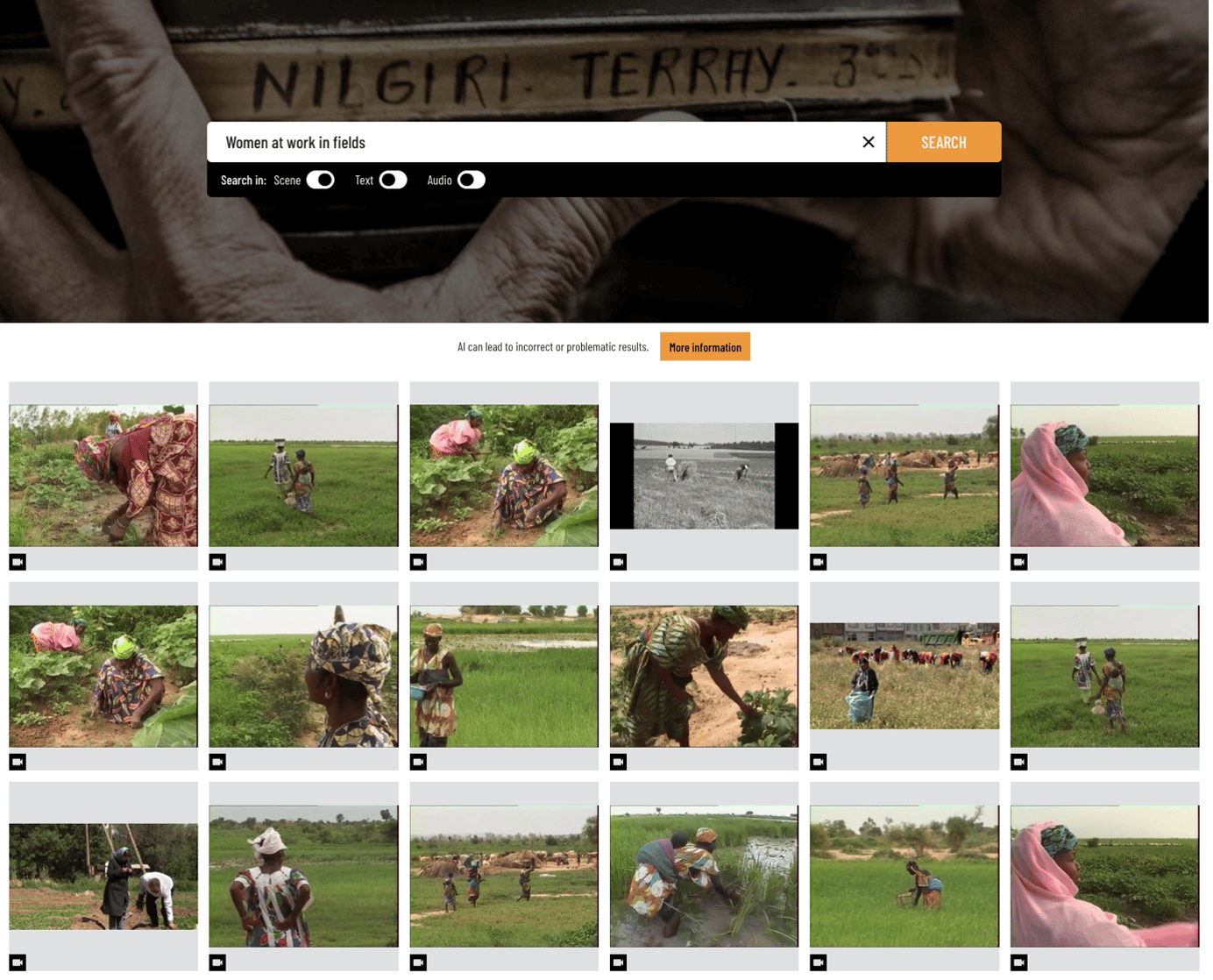
Image: Refining the query to “women at work in fields” narrows the results to footage of women working in agricultural settings.
Searching by visual concept
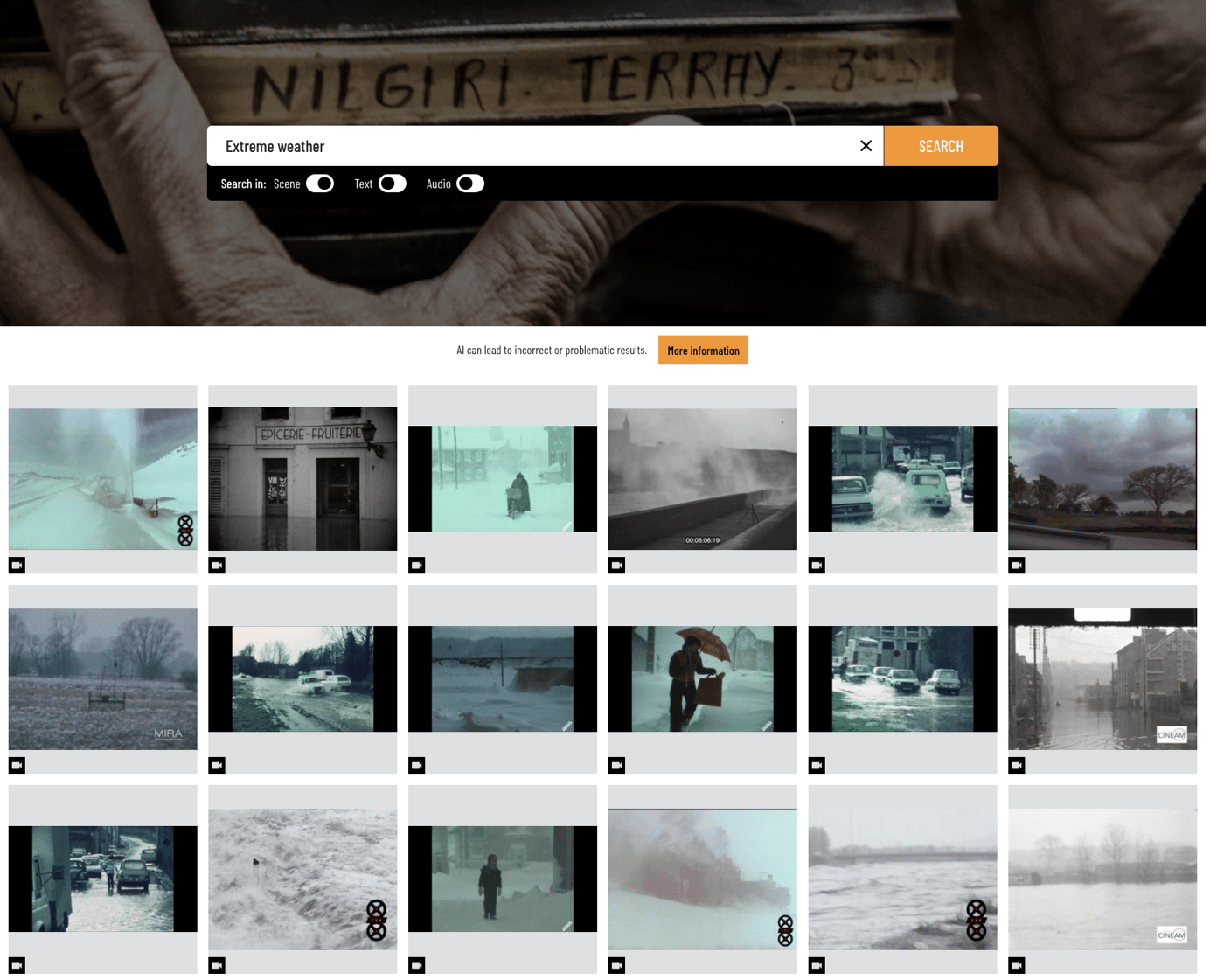
Visual search can also work at the level of scene, action, colour, or concept, not only named objects. A search such as “extreme weather” shows that the query can describe a visual concept and retrieve footage on that basis.
Image: Visual search results for “extreme weather”, demonstrating that a query can describe a visual concept alongside specific objects, actions, scenes, or colours.
Searching for text within a frame
Text recognition makes words that appear within a frame searchable, for example, words appearing on signs, banners, or opening titles. A search such as “café” shows how the search portal can retrieve the point where that word appears within the footage.
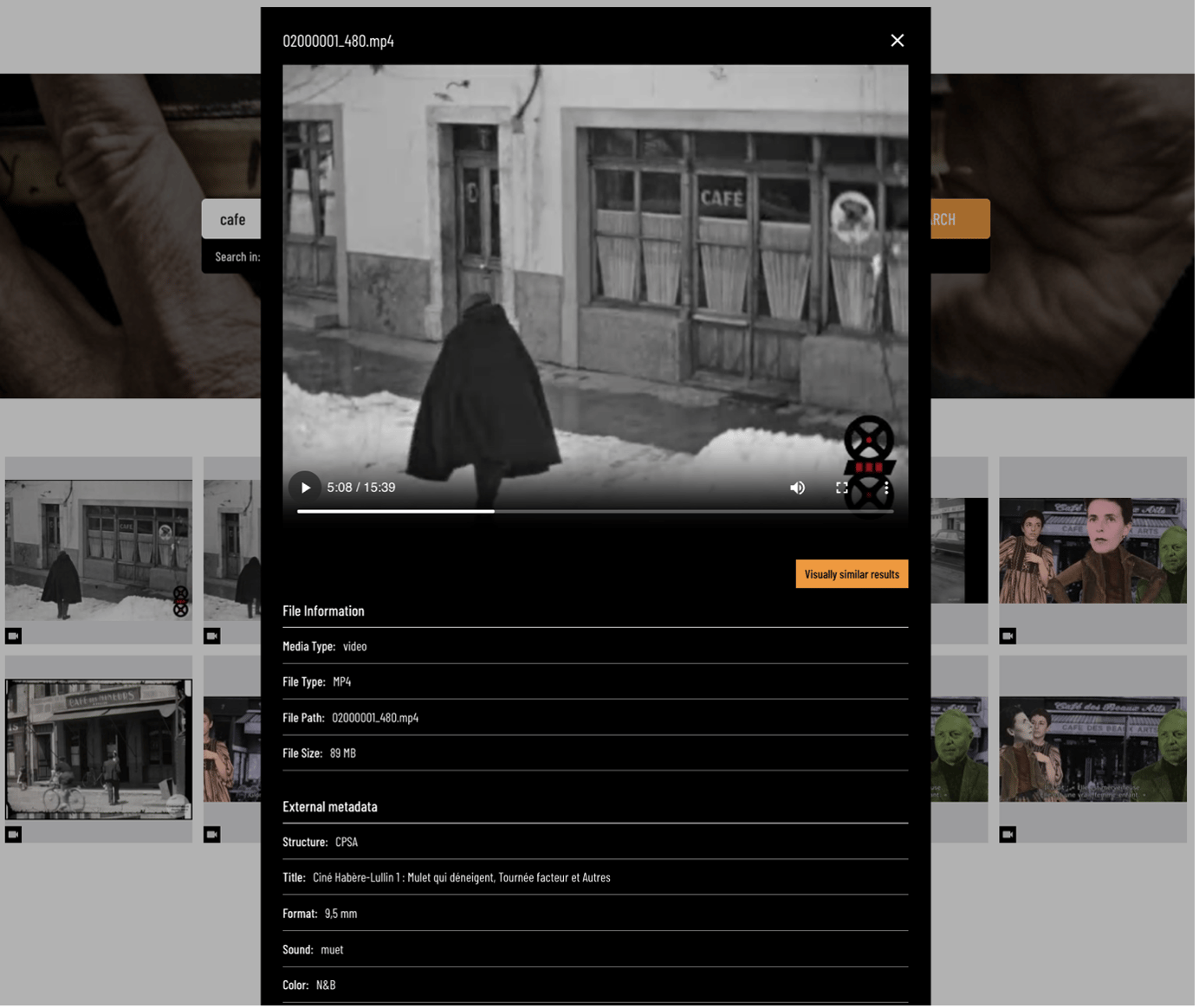
Image: Search result for “café”, showing how text recognition can retrieve the exact point in a film where a word appears within the frame.
Searching audio transcripts
For films with sound, the audio can be transcribed and searched as full text. A search such as “environnement” shows this layer in use. Audio transcript search is literal rather than cross-language, so queries need to be entered in the language spoken in the film. When a result is found within a film, the search portal opens playback at the relevant timestamp.
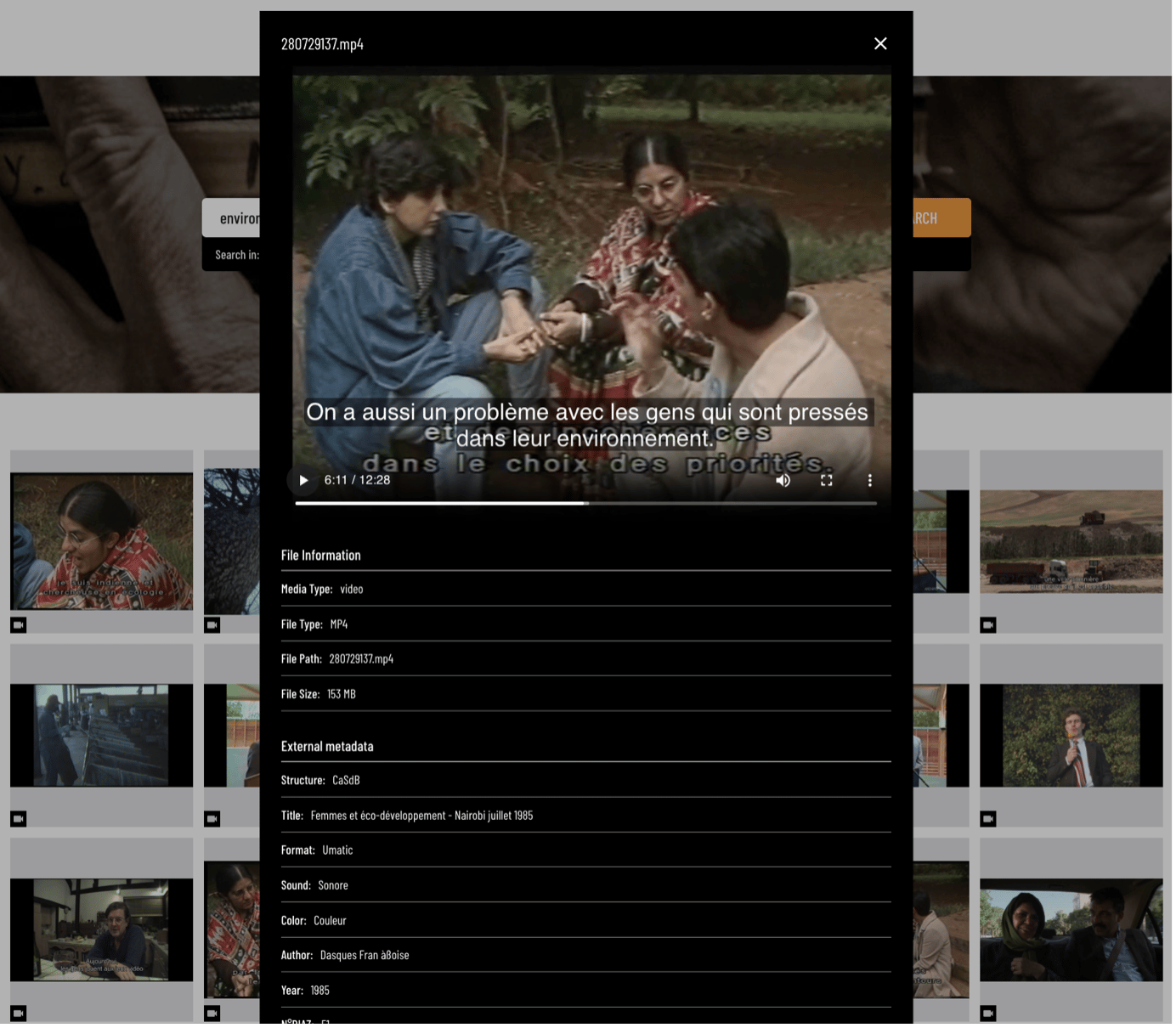
Image: Audio transcript search for “environnement”, with playback opening at the exact point where the word is spoken.
The search layers can be switched on or off as needed. Each film still links back to its original item record, so the search portal adds a new access layer without replacing the archive’s own catalogue description.
Results and limitations
The pilot showed that AI search could add access points that conventional description does not usually provide. AI Visual Search added a different route into the material by making it possible to search for visual elements, text within a single frame, and spoken words that archivists do not normally record in item descriptions.
At the same time, combining scene search, text recognition, and audio transcript search in one result set introduced noise. In practice, this meant that a user searching mainly for something visible in the footage could also receive results prompted by spoken words or by text appearing within a frame. That made the result set less intuitive when the main aim was to find a specific scene. Feedback from Diazinteregio indicated that the portal would work better if visual search were the default starting point, with text and audio search available when needed rather than included by default.
-
Make visual search the default home page. It was recommended that visual search become the default home page for the search portal, with text and audio search remaining available where required. This change has now been implemented and should reduce noise by placing visual results at the centre of the initial search.
-
Extend the search to a new set of films, this time ones that are not linked to a specific theme, as was the case with the environment.
-
Extend the search to include related documents. In future, when the Diazinteregio network publishes camera and projector equipment, posters, photographs and documentation associated with films on the Amorce platform, it would be useful for these to appear within the same search environment as the films. This would allow a single search query to return both moving images and documents, which is useful as research into the history of cinema often extends beyond the film itself to encompass all the surrounding documentation.
-
Development of AI-assisted indexing and cataloguing through pre-cataloguing. Whilst the Diazinteregio network champions the added value of human documentation, which provides detailed contextualisation linked to the history of the collections held by each organisation within the network, AI could be used to establish priorities for the processing of certain collections.
What This Means for Film Archives and Networks
This project shows one practical way for a network of archives to test a new technology. Diazinteregio already shares infrastructure, cataloguing standards, training, and a public platform. Applying AI Visual Search to one shared corpus allowed the network to assess the approach collectively rather than asking each institution to run its own isolated test.
It also shows where AI search is most useful in audiovisual collections. The value lies not in replacing catalogue records, but in adding new ways to explore the material itself while keeping archival metadata in place as the authoritative context.
About Archipanion
Archipanion helps archives, libraries, and museums use AI responsibly to improve collection search and access. Its two principal services are AI Metadata Extraction, which turns scanned documents into structured, searchable data, and AI Visual Search, which makes image and video collections searchable by their visual content. Its work is grounded in real collections and everyday workflows, and it shares case studies so that practical experience can contribute to wider, evidence-based learning across the sector.
Get in Touch
To discuss your image and audiovisual collections and how AI Visual Search might help, visit www.archipanion.com/en/contact-and-book-a-meeting.